
Paul AdamsDiplomatic correspondent

 BBC
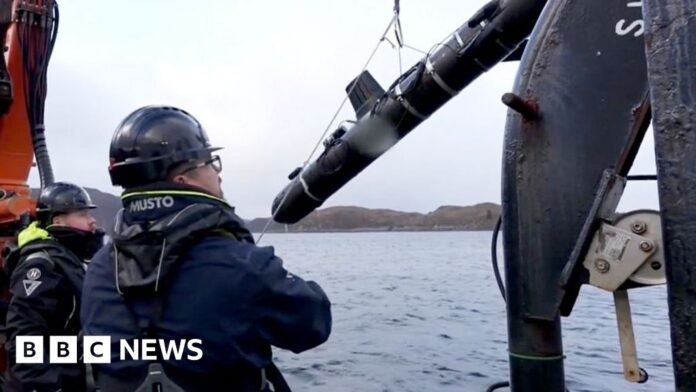
BBCIn the dark waters off the west coast of Scotland, a slender submarine glider, like a torpedo with wings, slips under the surface and quickly disappears off into the murk.
The SG-1 Fathom is on the prowl for intruders.
“The glider patrols through the depths of the ocean monitoring and listening for adversaries that might be in the area,” says Fathom’s programme manager Katie Raine.
Adversaries like Russian submarines operating covertly in or near British waters, suspected of working with spy ships to map the UK’s vital undersea cables and pipelines.
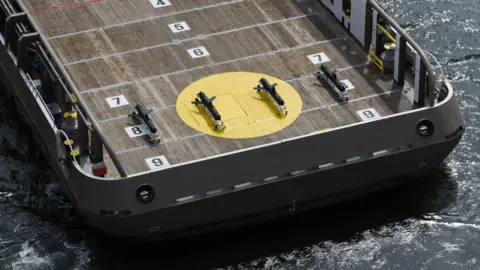
Fathom, made by the German defence company Helsing and now being trialled by the Royal Navy, moves silently, its sensors constantly gathering information.
It’s designed to patrol for months on end, working autonomously with dozens of other gliders, using software trained on decades of acoustic data.
“The glider processes and identifies threats more quickly than we’ve been able to do previously,” Raine says.
If it proves effective, Fathom will likely form part of Atlantic Bastion, a network of drones, warships and surveillance aircraft aimed at protecting vital undersea infrastructure.

The Ministry of Defence, which is unveiling elements of Atlantic Bastion on Monday, said in a statement that the programme was “in direct response to the resurgence in Russian submarine and underwater activity”.
The government says there has been a 30% increase in the number of Russian vessels threatening UK waters in the last two years. Russia says its the UK government that’s being provocative.
In September, the parliamentary National Security Strategy Committee said it was “not confident” the UK was equipped to protect its undersea cables, warning that an attack could cause “catastrophic disruption” to vital financial and communications systems.
Last month, the Yantar, a Russian oceanic research vessel suspected of mapping British undersea cables and pipelines, shone lasers at RAF pilots tracking its progress near UK waters.
Defence Secretary John Healey called the action “deeply dangerous”, saying the Yantar had repeatedly crossed in and out of the UK’s exclusive economic zone.
 Helsing
On a visit to Portsmouth last week, Healey stressed the government’s investment in new technology to combat the threat was vital.
“This is about keeping us ahead of the Russians,” he told me aboard the XV Patrick Blackett, the Royal Navy’s experimental ship used as a testbed for new technologies.
Some of those new technologies were on display, from a remote-controlled speedboat, zipping about in the harbour, to a mock-up of Proteus, the navy’s first pilotless helicopter.
On the dock above us loomed the black hull of Excalibur, a 12-metre-long, 19-tonne unmanned submarine, first launched earlier this year.
“We know the threat that Russia poses,” Healey said. “We track what their ships do. We track what their submarines are doing.
“We know that they are mapping our undersea cables and our networks and our pipelines, and we know that they are developing new capabilities all the time to put those at risk.”
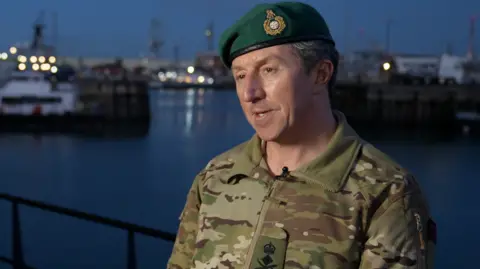
Accompanied by his Norwegian counterpart Tore O Sandvik as the two countries signed a defence pact – the Lunna House Agreement – to work together to hunt Russian submarines and protect underwater infrastructure, Healey said time was of the essence.
“It’s a rapidly evolving threat and that’s why it requires a rapid response from the UK.”
It’s a daunting challenge for the man charged with supervising Britain’s response, the First Sea Lord Gen Sir Gwyn Jenkins.
So how does the UK keep up with an opponent who hasn’t declared war but is investing heavily and behaving increasingly aggressively through increasingly complex means?
“Despite the cost of the war in Ukraine to [Russia], they continue to put hundreds of billions of dollars’ worth of investment into their submarine fleet,” he said.
“We’re still ahead in the Atlantic, but it’s not by as much of an advantage as I would like. We’re being pressed, and we’re definitely in the competition to stay ahead of where the Russians are.”
The recent episode involving a suspected spy ship, the Yantar, accused of aiming lasers at RAF pilots tracking its movement off the north coast of Scotland, was just the most visible example of Russia’s activity, he said. What worried him more was what was going on under the waves.
As part of this year’s Strategic Defence Review, the First Sea Lord is overseeing the Atlantic Bastion programme.
Much of it is relatively untested and critics say the navy lacks sufficient resources to do the job properly. But the general said the first devices would be in the water next year and he urged allies to join Britain in protecting data cables and supply lines.
Prof Peter Roberts, an expert on contemporary conflict at the Royal United Services Institute (Rusi), says the Royal Navy’s new strategy looks fine on paper but “feels like putting lipstick on a pig”.
He argues the UK has “neglected” its post-World War Two responsibility to be the guardian of the western Atlantic, and now the Royal Navy is “trying to find a way to look credible” in addressing a threat that has been “steadily increasing for the past 20 years… but still ignored by the government and Navy”.
“The Royal Navy does not have the ships to do this job coherently or credibly and is looking to address it with drones as they are cheaper and can provide coverage of the geographical areas for which the Royal Navy is responsible in lieu of new ships,” Prof Roberts adds.
“Russia so far is going unchallenged in much of UK water space and this strategy is playing catch up long after the fact.”
Russia says it’s Britain that’s being provocative, even hysterical.
Russian Foreign Ministry spokesperson Maria Zakharova told a news briefing in Moscow that the Lunna House Agreement was being used to justify “monitoring Russian naval activity” and risked “provoking unnecessary conflicts” in international waters.
But the military says it’s clear-eyed about the dangers. And it’s working closely with industry to address them.

Get our flagship newsletter with all the headlines you need to start the day. Sign up here.
Source link 2025-12-08 20:44:00 www.bbc.com https://www.bbc.com/news/articles/c3d01nxg0y0o?at_medium=RSS&at_campaign=rss


